
Are You Feeling Your Emotions or Thinking About Them?
You can understand exactly why something affected you and still feel upset about it.
You might know why a particular comment made you angry, recognise where your fear of rejection comes from, or understand why the end of a relationship has affected you so deeply.
You have thought about it, perhaps identified a pattern and reached an explanation that makes sense.
Yet the emotion remains.
Thinking about an emotion and feeling it are both valuable, but they serve different purposes.
A simple way to think about the difference is:
Thinking asks: “Why do I feel this?”
Feeling asks: “What am I experiencing right now?”
Thinking about our emotions
When something affects us emotionally, it is understandable to want to make sense of it.
We might replay what happened, examine our reaction, consider another person's behaviour or connect the experience with something from our past.
We might ask:
“Why did that affect me so much?”
“Where does this reaction come from?”
“What does this mean?”
Reflection can help us organise our experiences, recognise patterns and develop greater insight into ourselves. The difficulty isn't that we think about our emotions. Sometimes, however, thinking can become our main way of relating to them. We become very good at explaining what we feel without necessarily noticing what the emotional experience is like.
What does it mean to feel an emotion?
Feeling brings our attention from explanation to experience.
Instead of immediately asking why something is happening, we notice what is happening.
Emotions can be experienced through bodily sensations, thoughts, memories, urges and changes in our behaviour.
For example:
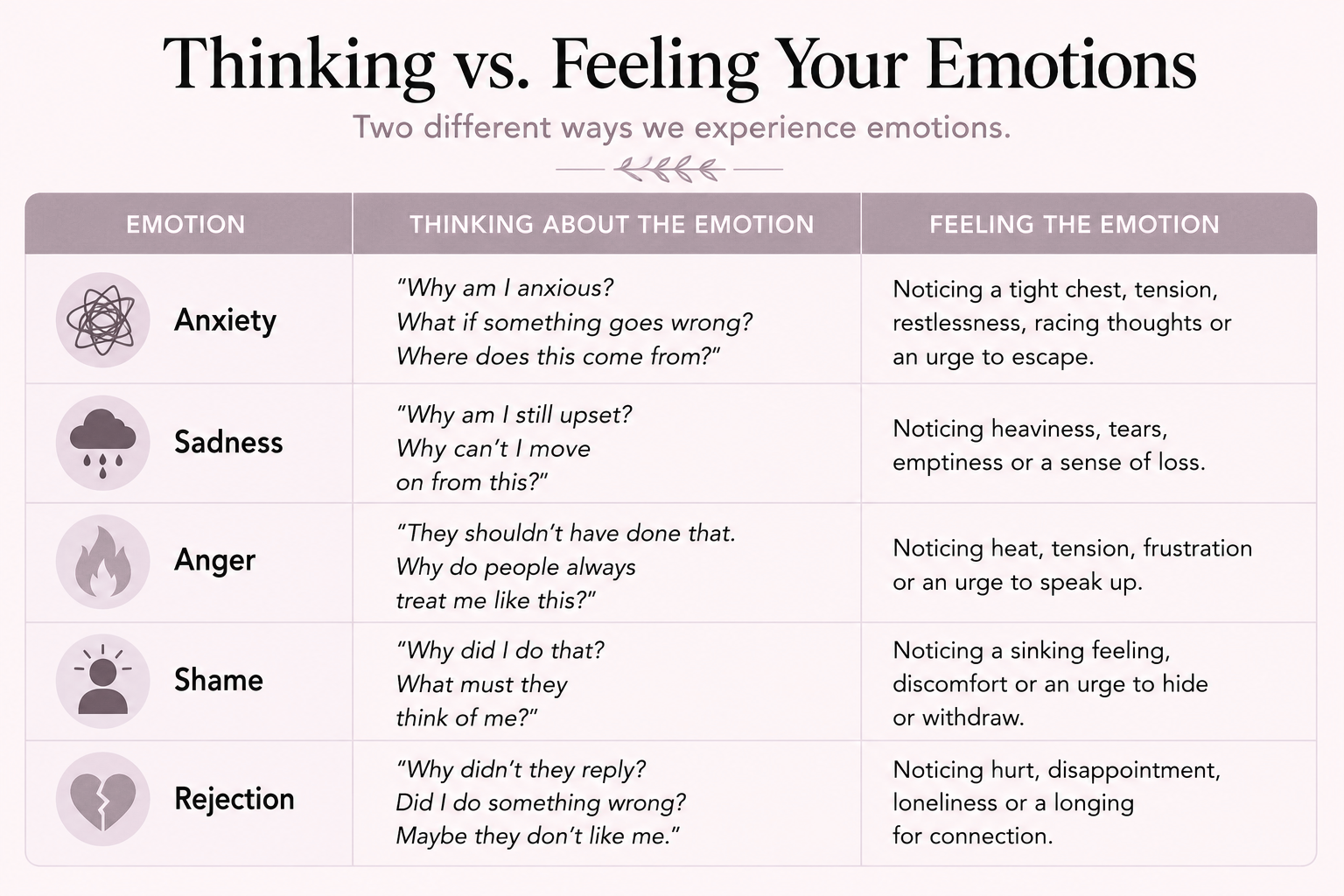
These experiences will differ from person to person. There isn't one physical sensation or response that belongs to a particular emotion. Feeling also doesn't mean switching off your thoughts. Thoughts are part of our emotional experience. The difference is where our attention goes.
Are we mainly trying to explain the emotion, or are we also allowing ourselves to notice what we are experiencing?
What might this look like in everyday life?
Imagine a friend cancels plans at the last minute. You might immediately start thinking:
“They probably don't value me.”
“Why does this always happen?”
“Maybe I've done something wrong.”
You might replay previous interactions and try to work out what the cancellation means. At the same time, underneath all that thinking, you might feel disappointed, hurt, angry or lonely. Thinking can help you consider what happened and what meaning you are giving to it. Feeling means also noticing the emotional impact the situation has had on you. Sometimes we move so quickly into trying to understand an experience that we don't pause long enough to recognise what we are actually feeling.
Why might we move towards analysis?
Thinking can bring structure to something that feels confusing. Finding an explanation can help us understand what happened, recognise patterns and decide what we want to do next. For some people, analysis may also create distance from difficult emotions.
If sadness, fear, anger or vulnerability feels difficult to experience, trying to understand the emotion may feel more manageable than remaining with it.
Psychology sometimes describes this through the concept of intellectualisation. Intellectualisation is when someone focuses predominantly on the facts, explanations or reasoning surrounding an experience while remaining more removed from its emotional content.
However, analysing an emotion isn't automatically intellectualisation or avoidance.
Reflection can be useful.
A more helpful question might be:
Is my thinking helping me connect with what I am experiencing, or am I spending most of my time analysing the experience without actually noticing how I feel?
Understanding isn't always the same as processing
This is where the distinction becomes particularly important. You may understand exactly why you are anxious and still experience anxiety. You may understand why the end of a relationship hurt you and still feel sadness. You may recognise why rejection affects you strongly and still experience that hurt when it happens.
Insight gives us understanding, but understanding doesn't necessarily mean the emotional response will change.
Emotional processing involves engaging with the emotion itself as well as understanding the situation around it.
This can include identifying what you are feeling, noticing what happens in your body, recognising accompanying thoughts or urges, and allowing the emotion to be present without immediately trying to solve it, explain it away or make it disappear.
When an emotion is experienced rather than continually pushed aside, it has an opportunity to move through its natural course. The intensity may rise, change and eventually reduce. This doesn't mean that feeling an emotion once means it will never return. Sadness, anxiety, anger or hurt can arise again in response to new situations, memories or triggers.
The difference is that processing allows us to experience what is present rather than only thinking about it from a distance. If we repeatedly move into analysis whenever an uncomfortable feeling appears, we may understand the emotion intellectually while avoiding the emotional experience itself. In some cases, this can contribute to emotions being pushed aside or suppressed rather than processed.
Processing, then, isn't simply about getting rid of an emotion. It is about allowing an emotional response to be experienced and to run its course, while recognising that emotions are part of an ongoing experience and may return.
Both thinking and feeling matter
The point isn't to stop analysing your emotions.
Thinking helps us make connections, understand ourselves, consider different perspectives and learn from our experiences. Feeling gives us access to another part of that experience. We might notice sadness, become curious about it and then reflect on what it is connected to. We might recognise anger, notice what it is telling us and consider whether a boundary needs attention. We might experience anxiety and then explore what our mind believes is threatening or uncertain.
Thinking and feeling can work together.
Something to notice
The next time you find yourself analysing an emotional experience, you don't need to stop thinking about it.
Simply add another question.
Alongside:
“Why do I feel this way?”
try:
“What am I experiencing right now?”
Thinking helps us make sense of what we feel.
Feeling allows us to experience and process it.
We need both.