What Traditional Chinese Medicine Can Teach Us About Emotions and the Body
- Carlotta Self Healing Clinic
- Mind-Body Connection
In Western psychology, emotions are often discussed through thoughts, behaviours, attachment patterns, trauma responses, or nervous system activation. Emotional distress is frequently approached cognitively first. We analyse what we think, why we react the way we do, how our past experiences affect us, and how emotional patterns develop over time.
Traditional Chinese Medicine approaches emotions differently.
Rather than separating emotional and physical experience, Traditional Chinese Medicine views the mind and body as interconnected. Emotions are not understood as something happening only psychologically, they are considered part of the entire internal system, influencing energy, physical functioning, behaviour, and bodily states simultaneously.
This perspective can feel unfamiliar in modern Western culture, where physical symptoms and emotional experiences are often treated separately. We may go to one professional for anxiety, another for digestive discomfort, another for sleep issues, and another for chronic tension, without necessarily exploring how these experiences interact with one another.
Traditional Chinese Medicine invites a different way of observing ourselves.
Within this framework, emotions are associated with different organs and bodily systems. For example, grief is linked to the lungs, anger and frustration to the liver, fear to the kidneys, and overthinking to the spleen.
This can encourage us to notice how emotions may appear physically in the body.
For example, stress doesn't only happen mentally, it may appear as shallow breathing, chest tightness, digestive discomfort, fatigue, jaw tension, headaches, muscle pain, skin issues, restlessness, or difficulty sleeping. Emotional overwhelm may create physical exhaustion. Fear may create contraction and hyper-vigilance. Grief may feel heavy and consuming physically, not only emotionally.
Some emotional states are difficult to describe cognitively but become clearer physically.
A person may say:
“I don’t know what I feel.”
But physically they notice:
A tight chest.
A sinking stomach.
Tension in the shoulders.
Exhaustion around certain people.
Difficulty relaxing.
A body that feels constantly alert.
Traditional Chinese Medicine pays close attention to these patterns.
One of its central concepts is the Chinese Body Clock. This system divides the 24 hour day into different 2 hour periods, with each period associated with a particular organ and its functions. According to Traditional Chinese Medicine, energy, or “Qi”, moves through the body in cycles, and different systems become more active at different times.
In Western medicine, organs are usually discussed biologically.
The liver detoxifies.
The lungs breathe.
The stomach digests.
Traditional Chinese Medicine expands this understanding by exploring emotional and energetic relationships as well.
For example, waking consistently between 1am and 3am is associated with the liver. In Traditional Chinese Medicine, this period is linked to anger, frustration, irritability, and emotional processing.
Similarly, the hours between 3am and 5am are connected to the lungs and grief.
Morning digestive discomfort and overthinking are associated with the stomach and spleen systems.
Whether interpreted symbolically, philosophically, or practically, these ideas encourage us to notice recurring patterns between stress, physical symptoms, emotions, sleep, and daily rhythms.
This doesn't mean that waking during certain hours automatically reveals hidden emotions or internal imbalance. The Chinese Body Clock should not be treated as a literal diagnostic tool. However, it offers an interesting framework for observing the relationship between the body and emotional experience.
It also encourages us to ask different questions.
Instead of asking only:
“What am I thinking?”
We may start asking:
What is my body doing right now?
When does tension appear?
What physical patterns repeat during stress?
What happens in my body during emotional overwhelm?
When do certain emotions become strongest?
These questions shift attention away from seeing the body purely as something mechanical that needs to keep functioning, and instead, the body becomes a source of information.
This perspective also changes how we think about emotional awareness.
Some of us become aware of emotions mentally first. We analyse, reflect, intellectualise, and attempt to understand ourselves cognitively.
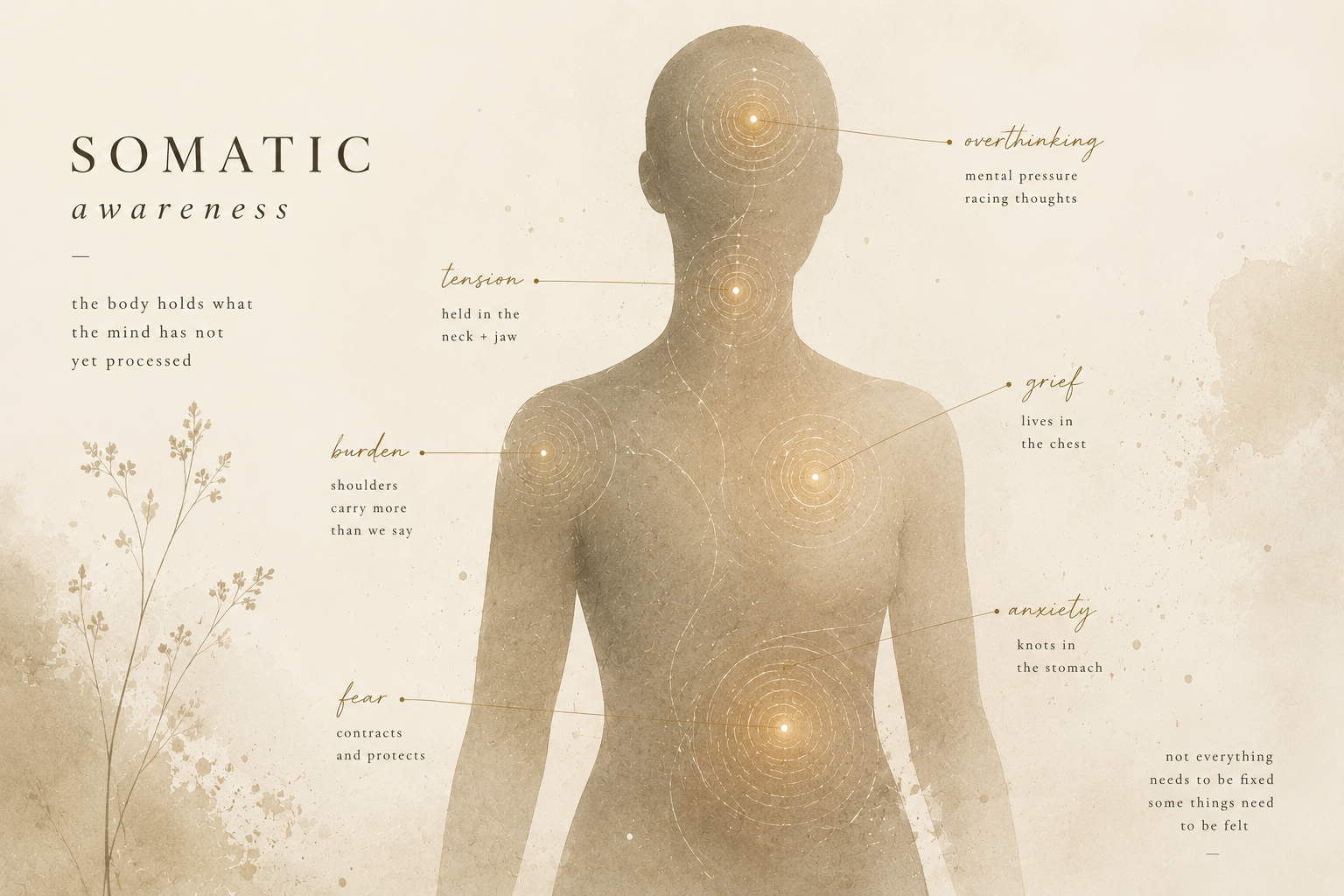
Others notice emotions physically before they fully recognise them emotionally.
The body reacts first.
The stomach tightens before the mind identifies anxiety.
The chest feels heavy before grief is consciously acknowledged.
The body becomes restless before anger is expressed.
The shoulders tense before we recognise emotional pressure.
This is partly why body awareness has become increasingly important within somatic perspectives and body based approaches to emotional wellbeing. Although somatic approaches and Traditional Chinese Medicine come from very different traditions, both recognise that emotions are not experienced only through thought.
Physical sensations, posture, breathing, movement, exhaustion, tension, and nervous system activation may all become part of emotional experience.
Traditional Chinese Medicine encourages a slower and more observational relationship with these experiences.
Not:
“How do I get rid of this feeling immediately?”
But:
“What is this experience communicating?”
“What patterns do I notice?”
“What changes when I pay attention rather than suppress?”
Paying attention to the body can start very simply with pausing, noticing tension, observing breathing, recognising physical responses around certain situations or people, becoming curious about recurring emotional and physical patterns.
Traditional Chinese Medicine offers one framework for thinking about these experiences. Western psychology offers another. Somatic approaches offer another. None provide a complete answer on their own.
What connects them is the recognition that emotions are not experienced only through thought. The body is often involved long before the mind fully understands what is happening.
If you would like to explore this further, you can access free Traditional Chinese Medicine Body Clock guide here.