
How We Accidentally Prove Our Core Beliefs True
- Carlotta Self Healing Clinic
- Understanding Feelings
We like to think our thoughts are objective reactions to the world around us. We assume that when we feel anxious, rejected, or overwhelmed, it is because of the exact situation happening right in front of us. In reality, our thoughts are often driven by deeply ingrained core beliefs, and these hidden assumptions act like a lens that distorts how we see ourselves, how we interpret situations, and ultimately, how we behave.
To understand why we get stuck in repetitive mental traps, we have to look at the underlying architecture of human psychology. When you want to learn how to break a cycle, you first have to understand where it starts and how it sustains itself over time.
What Are Core Beliefs?
A core belief is a deeply held assumption about yourself, other people, or the world. Unlike everyday thoughts, core beliefs tend to operate in the background of awareness and often feel less like beliefs and more like facts.
Many core beliefs develop through repeated experiences, important relationships, family messages, cultural influences, or significant life events. They are the conclusions we arrive at when trying to make sense of our experiences. At the time, these conclusions may have served an important purpose, helping us understand our environment and navigate the challenges around us.
To manage the enormous amount of information we encounter every day, our minds rely on mental shortcuts known as schemas. Core beliefs form part of the foundation of these schemas. They influence what we pay attention to, how we interpret situations, and what we expect from ourselves, other people, and the world around us.
Because human beings tend to prefer consistency, we are often drawn towards information that supports our existing beliefs and may overlook information that contradicts them. This tendency, known as confirmation bias, helps explain why certain beliefs can persist even when they create distress or limit our lives.
When a belief has been repeated over many years, it can become increasingly convincing. Experiences that support the belief may stand out more readily, while experiences that challenge it can be dismissed, forgotten, or explained away. As a result, the belief starts to feel less like an interpretation and more like reality itself.
The Anatomy of a Maintenance Cycle
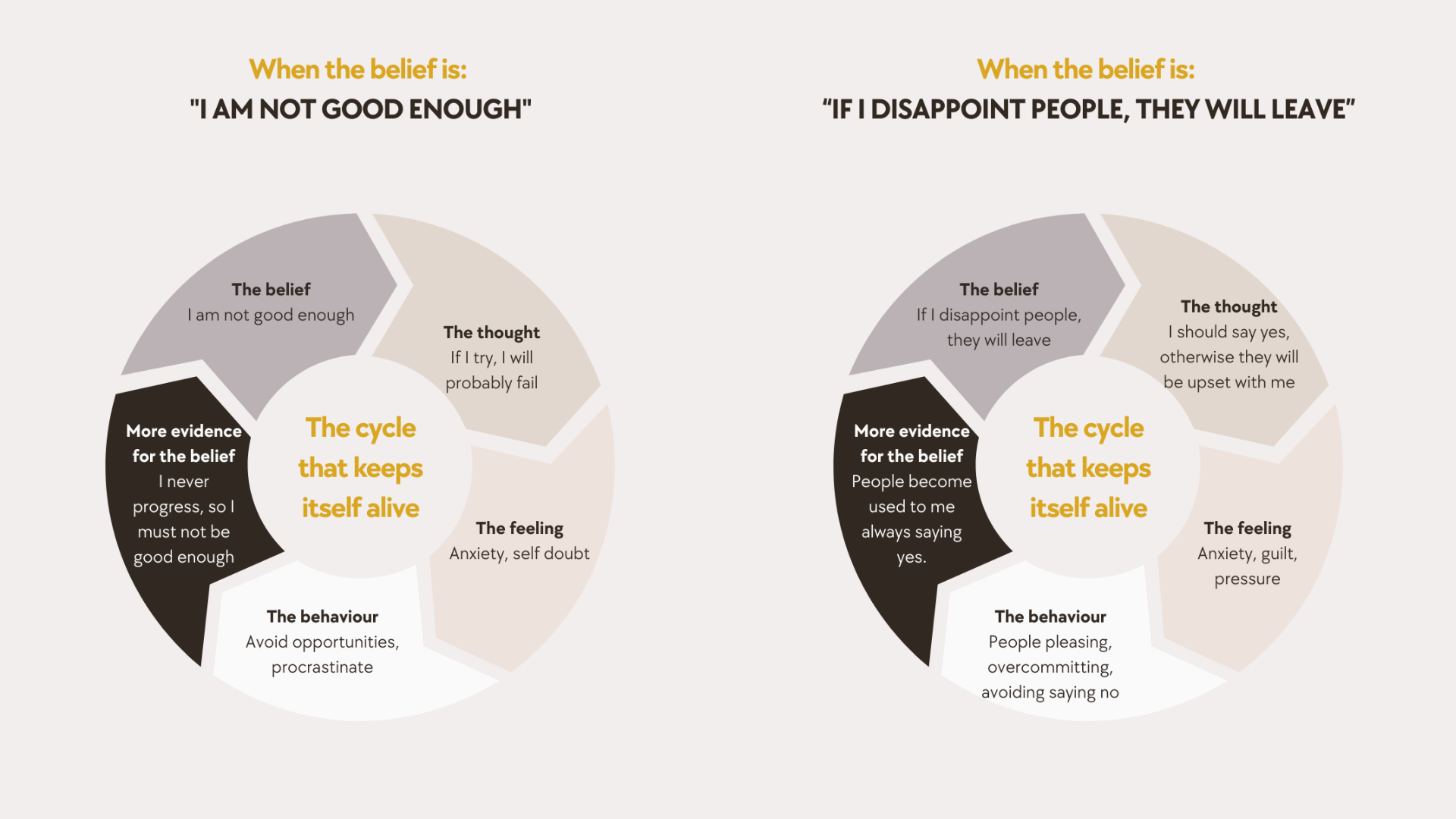
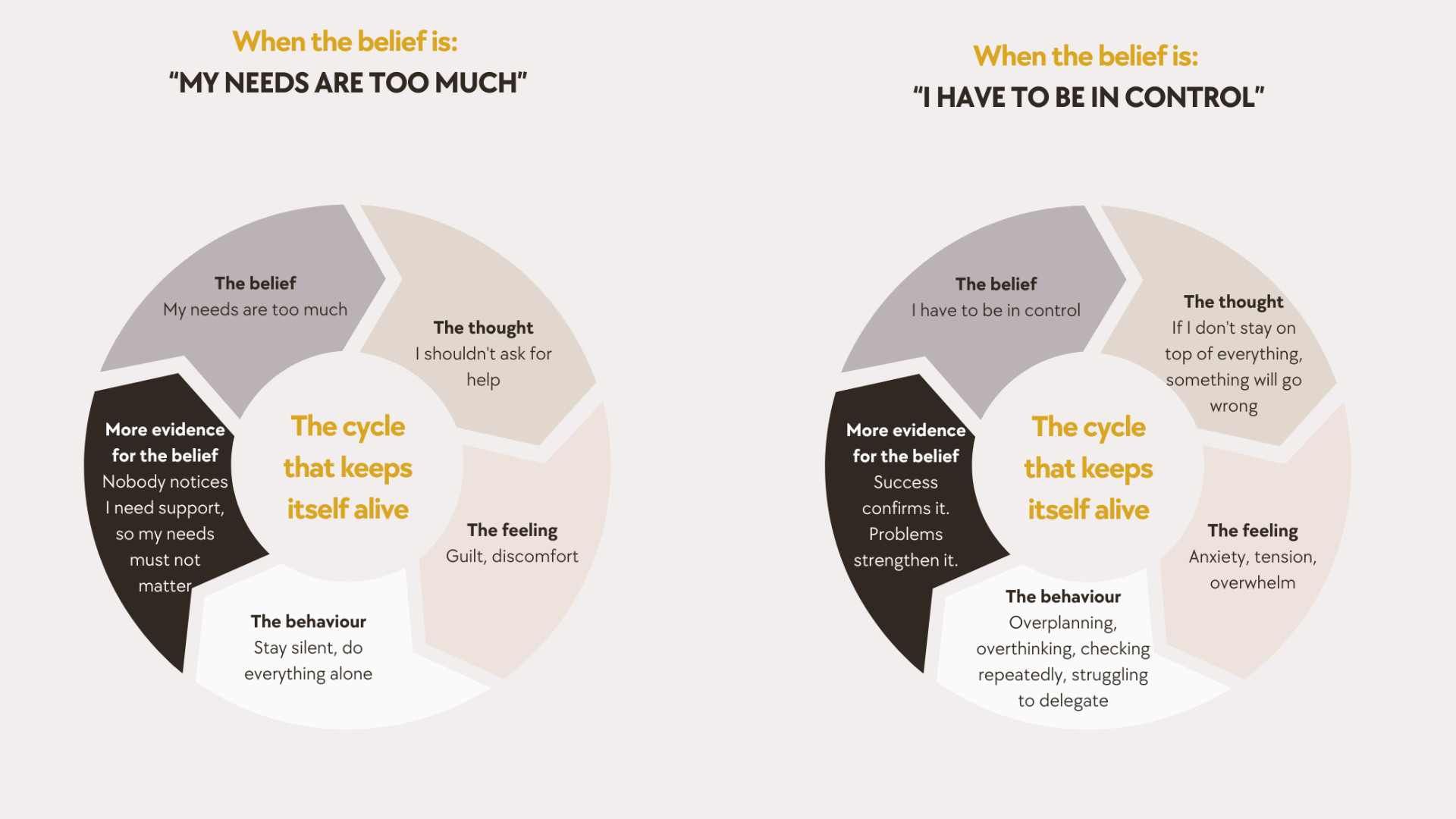
When we hold an unhelpful core belief, this desire for internal consistency sets off an automatic chain reaction that dictates our daily lives. This chain reaction follows a sequence:
The Belief creates an automatic Thought.
The Thought triggers an uncomfortable Feeling (like anxiety, guilt, or shame).
To cope with that feeling, we engage in a defensive Behaviour (like avoiding, overworking, or people-pleasing).
That Behaviour ultimately creates an outcome that provides evidence to reinforce the original belief.
This is a loop, often referred as a maintenance cycle. The outcome didn't happen because the belief was an objective truth; the outcome happened because the loop forced it to occur. These cycles explain exactly how a pattern can stay alive for years. The very behaviours we use to protect ourselves from our deepest insecurities are the exact actions that keep those insecurities alive.
Limiting Core Beliefs Examples in Daily Life
-
I have to be perfect to be acceptable
If a person holds the belief that their value depends entirely on being flawless, a minor mistake on a project triggers an automatic thought: the entire project is a failure and they are incompetent. This thought can create intense anxiety. To cope with that discomfort, they might overwork themselves to the point of complete burnout, or they might procrastinate and avoid finishing it at all to evade the pain of imperfection. When they inevitably exhaust themselves or miss the deadline, their mind registers the failure and says, see, I really cannot do anything right. The loop has successfully gathered its own evidence, completely filtering out the fact that the burnout caused the mistake, not a lack of actual ability.
-
I am unlovable and people will always leave me
If a person holds this belief, they might mistake a simple delayed text message for a definitive sign of impending abandonment. The resulting panic might drive them to push the other person away first to protect themselves from being hurt, or to cling so tightly that they demand constant reassurance. When the relationship becomes strained under that pressure and the other person pulls back to create space, they may interpret that distance as proof that everyone leaves eventually.
-
The world is not safe
If a person holds the belief that danger is always around the corner, everyday situations can start to feel loaded with risk. News stories attract attention. Worst case scenarios come to mind quickly. Uncertainty feels difficult to tolerate. The result may be constant vigilance, excessive preparation, reassurance seeking, or avoiding situations that feel unpredictable. These behaviours can reduce anxiety in the short term, but they also prevent opportunities to discover that many situations are safer than expected. Over time, the absence of danger is often attributed to being careful enough, rather than evidence that the threat was lower than imagined. The belief remains intact because every safe outcome is credited to vigilance.
-
My value comes from achievement
If a person holds the belief that their worth depends on what they accomplish, success can become more than a goal. It becomes a measure of identity. Achievements create temporary relief, but the feeling rarely lasts. Attention quickly shifts to the next target, the next milestone, or the next thing that needs improving. Rest can feel uncomfortable. Doing nothing can feel wasteful. Falling short can feel personal. Because self worth is tied to performance, achievements become necessary rather than satisfying. The person keeps moving, but the feeling of being enough remains just out of reach.
More examples
How to Identify Your Core Beliefs
Before exploring how core beliefs can change, it is necessary to identify them. This is often more difficult than it sounds because core beliefs rarely present themselves as beliefs. They tend to feel like facts about ourselves, other people, or the world.
One technique sometimes used in cognitive therapy is called the downward arrow technique.
The aim is not to analyse every thought, but to gradually reveal the assumptions sitting beneath a chain of thoughts and worries.
Start with a situation that triggered a strong emotional reaction and identify the automatic thought that followed. Then ask yourself, "If that were true, what would it mean about me?" Continue following the chain of meaning rather than stopping at the first answer.
For example, "My manager wants to speak to me" may lead to "I wonder if something is wrong." Following that further may lead to "I need to know what this is about." Going further still may reveal thoughts such as "I can't relax until I have an answer" or "I need to prepare for every possibility."
Asking, "If that were true, what would it mean?" can gradually uncover a deeper belief such as, "If I am not in control, I am not safe."
The core belief is often not immediately obvious because it sits underneath layers of thoughts, worries, and assumptions. The downward arrow technique helps trace those layers back to the meaning that is driving them.
The process is not always straightforward. Core beliefs are rarely uncovered in a single sitting, and different situations may point towards different themes. It can also be difficult to distinguish between a passing worry and a belief that has been operating for years.
Identifying a core belief doesn't automatically change it. However, it does make something important possible. A belief that was previously operating in the background can now be observed, questioned, and explored. What once felt like an unquestionable fact begins to reveal itself as a particular way of understanding experience.
That shift may seem small, but it is often where meaningful change begins.
How to Intercept the Loop
Recognising a pattern is often an important step, but it is rarely the same as changing it.
Core beliefs are not simply ideas that can be replaced through logic alone. They are often reinforced by years of experience, repetition, emotion, and habit. For that reason, insight alone doesn't always lead to change.
A person may recognise that they fear rejection and still feel anxious when sending a message. They may understand that they are not responsible for everyone else's emotions and still experience guilt when setting a boundary. Awareness and change are related processes, but they are not identical.
What awareness does offer is choice.
The familiar thoughts, emotions, and urges may continue to appear, but they no longer have to operate entirely outside awareness. The pattern becomes something that can be observed rather than automatically followed.
One way of working with these patterns is through behavioural experimentation. This involves responding differently to the situation and observing what happens.
The aim is not to prove a belief wrong overnight, nor is it to force yourself to think positively. The aim is to create opportunities for new experiences that the existing belief may not predict.
This process can feel uncomfortable. Core beliefs often developed for understandable reasons. They may have been attempts to create safety, belonging, predictability, or protection in earlier circumstances. As a result, behaving differently can initially feel unfamiliar, risky, or emotionally exposed.
The discomfort doesn't necessarily indicate that the new behaviour is wrong. Sometimes it reflects the fact that an established way of understanding yourself, other people, or the world is being challenged. Over time, new experiences may start to sit alongside the old belief. The original belief may continue to appear, particularly during periods of stress or vulnerability.
Rather than viewing change as the removal of a belief, it can be helpful to think of it as developing a different relationship with it. The belief may still arise, but it no longer has the same influence over how situations are interpreted or how choices are made.
The goal is not to win an argument against the belief.
The goal is to create enough new experiences that the belief is no longer the only explanation available.
The maintenance cycle can help explain how a belief stays alive, but it doesn't necessarily explain why that belief became important in the first place. Beneath many core beliefs sits a deeper meaning that is often connected to safety, belonging, acceptance, connection, autonomy, or protection.
A belief such as "I have to be perfect" may not really be about perfection. It may be connected to avoiding criticism, maintaining approval, or feeling worthy.
A belief such as "I have to be in control" may be less about control itself and more about creating a sense of safety in the face of uncertainty.
When attention is focused only on changing thoughts or behaviours, it is possible to miss the significance of what the belief has been trying to achieve. This doesn't mean the belief is helpful in the present, nor does it mean it should remain unchallenged. However, understanding the meaning attached to a belief can provide a richer understanding of why it has persisted for so long.
The question gradually shifts from "How do I get rid of this belief?" to "What has this belief been doing for me?" and "What need has it been trying to meet?" These questions often reveal a more compassionate and nuanced understanding of the pattern, making change easier to approach without reducing it to a simple battle against negative thinking.