
Suppressing Feelings vs Sitting With Them: Why it feels easier to avoid and what changes when you don’t
- Carlotta Self Healing Clinic
- Understanding Feelings
It often feels easier to suppress feelings than to stay with them. Not because we don’t know what we feel, but because of what feeling actually involves. Feelings are not only thoughts. They are lived through the body. They show up as tightness, pressure, heat, restlessness, heaviness. They are sensations we can locate and notice, not just ideas we can describe.
This is also why they are called feelings. They are not only something we think about, but something we physically experience.
Moving away from that intensity gives immediate relief. We regain a sense of control, the discomfort drops, and we continue with what we were doing. That relief teaches us that leaving the experience works, and over time, this can become automatic.
We can start to believe we are dealing with feelings because we think about them, analyse them, or explain them. Yet the experience itself has not been processed, and the cycle has been interrupted. The difference between suppressing and sitting with feelings sits exactly there.
What suppressing feelings actually is
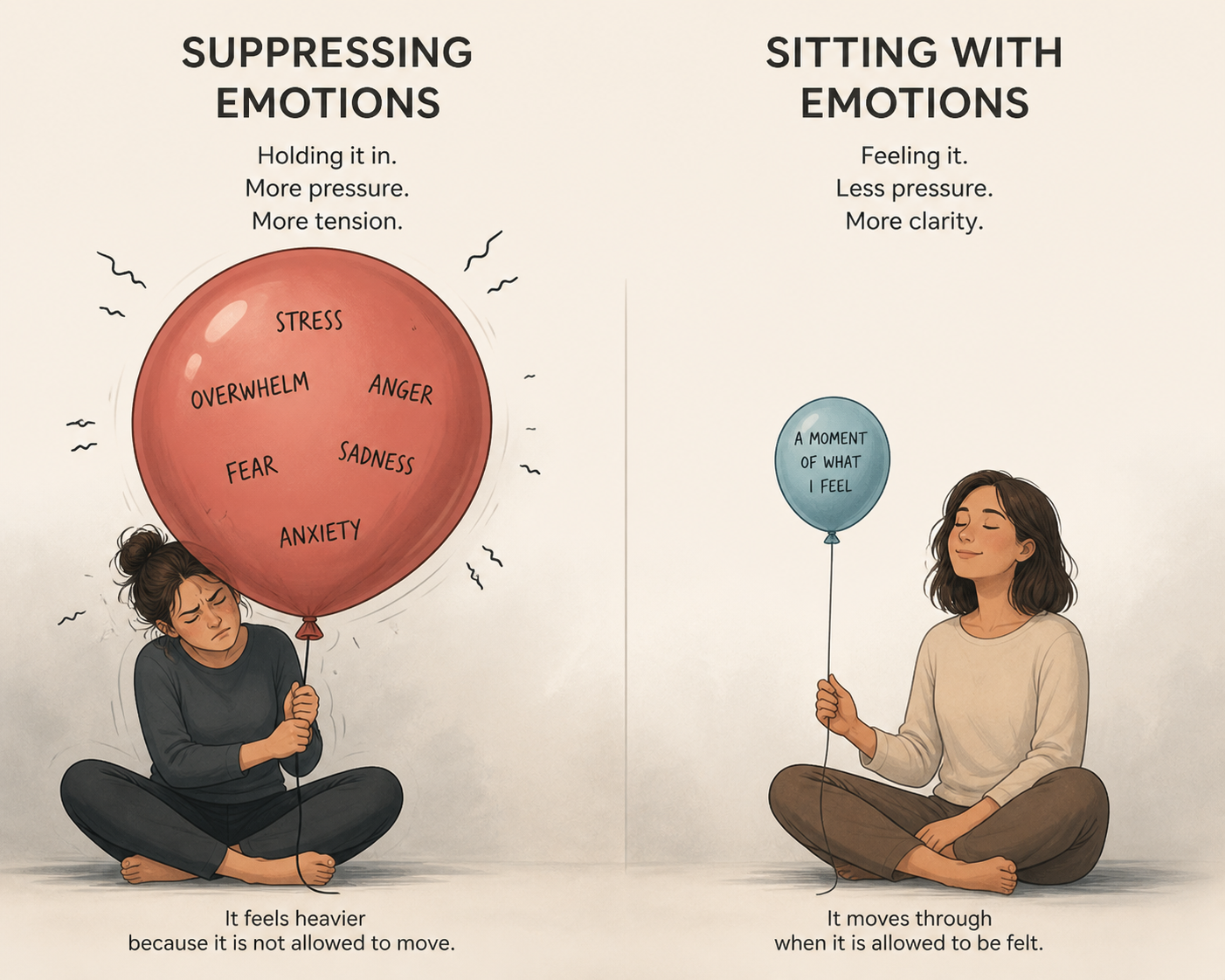
Suppressing feelings is about moving attention away from the direct experience of the feeling.
We may replay the situation in our mind, explain why it happened, or decide what we should do next. All of this can happen while we are no longer in contact with the feeling itself. The part that is felt in the body has been set aside.
Why it feels easier to suppress
It’s natural to avoid feeling something uncomfortable. Staying with a feeling means remaining in contact with something that doesn’t feel controlled or predictable. There is a protective side to this. The mind tries to help us avoid intense or painful feelings.
When something affects us deeply, it leaves a trace. If a similar situation appears again, the body reacts quickly.
The difficulty is in how this protection shows up. Avoiding one feeling often means staying away from others that sit underneath it. This can lead to a sense of disconnection or emptiness over time.
What we call negative feelings are part of the human experience, and trying to avoid them is not only unrealistic but also unhelpful.
Feelings, both pleasant and unpleasant, are closely linked to relationships. There is an interdependence between what we feel and how we relate to others. They influence each other. For example, feeling guilt after upsetting someone can lead us to repair what happened or avoid repeating the same action. In this sense, even uncomfortable feelings can guide how we interact and respond.
Anxiety signals uncertainty, threat, or pressure, and it can activate us to respond. A moderate level of anxiety can help us prepare, focus, and engage with what matters. It can indicate that something is important. However, when it becomes too high, it affects attention, concentration, and the ability to respond effectively. It can feel as if the body is in a constant state of alertness. Anxiety becomes more difficult when it is linked to repetitive thinking and an overestimation of risk, combined with an underestimation of our ability to cope.
Sadness signals loss or absence. This could be the loss of a person, a relationship, a situation, or something meaningful. When sadness is recognised, it can allow us to process that loss, adjust, or respond to what is missing.
Anger signals that something feels unjust or that an expectation has not been met. Without it, it would be difficult to recognise when something matters to us or to express dissatisfaction.
What all of these share is that they point to something.
What is actually happening when we feel something
When something happens to us, it is not processed in one way only. It moves through different channels at the same time. There is what happens in the body, what we feel, and how we make sense of it.
These are connected.
A sensation can appear in the body in a specific moment. For that sensation to be fully processed, it needs to be noticed, recognised as a feeling, and linked to what is happening.
If this doesn’t happen, the sensation doesn’t disappear. It can remain at a physical level without being processed.
Suppression doesn’t only interrupt the feeling, but it interrupts the full processing of the experience.
Feelings are signals, not something to manage
We are often taught to control or manage feelings, as if they are something that need to be handled or contained. Yet feelings point to something. They indicate what is happening internally and in relation to what is around us. When we suppress feelings, we are not only reducing discomfort, we are also ignoring what they are pointing to.
What happens when we hold feelings in
Not only feelings, but reactions, impulses, and parts of ourselves. There can be an attempt to keep everything contained, as if expressing something might lead to losing control or creating distance. We hold back expression to avoid consequences. Over time, this extends beyond specific moments. We start to hold back how we respond, what we say, and how we exist with ourselves and others.
A feeling has a natural movement. It rises, reaches intensity, and then reduces. When we suppress it, that movement is interrupted. The body remains activated even if the outward reaction is controlled.
This can show up later as tension that stays in the body, thoughts that repeat, or reactions that feel stronger than expected. The feeling has not disappeared. It has shifted.
What if we allowed ourselves to sit with the feeling instead of suppressing it?
Sitting with a feeling is not about analysing it or explaining it. It means staying with the experience as it is happening. Instead of asking why we feel this way, we notice what is happening in the body and allow it to be there for a short period. This is where the feeling can run its course.
How to sit with feelings in practice
Pause
Notice when something shifts in you.
Name
Use one word for the feeling.
Locate
Ask yourself where you feel it in your body.
Stay
Keep your attention on that sensation for around 20 to 30 seconds.
Observe
Notice any change, even if it is small.
What feeling are you most likely to move away from?
Where do you notice it in your body when it appears?
Can you stay with that sensation, even briefly, without changing it?