The Karpman Drama Triangle: How Victim, Rescuer, and Persecutor Roles Show Up in Your Relationships
- Carlotta Self Healing Clinic
- Personal Growth
There are some conversations that seem to follow a script, even when the people and the circumstances are different. You may start with good intentions, wanting to listen, help, or sort things out, and still find yourself leaving the interaction feeling irritated, blamed, or emotionally pulled in. In other situations, you may feel cornered from the start, as though there is no good response available.
The Karpman Drama Triangle helps put words to this kind of pattern.
First described by Stephen Karpman in 1968, the Drama Triangle is a way of understanding recurring conflict and relational tension. It describes 3 roles that people often move between in difficult interactions: Victim, Rescuer, and Persecutor. These roles are not fixed identities, and they are not a way of sorting people into categories. They are positions that people can slip into when tension rises, needs go unspoken, or emotions begin driving the conversation.
What makes the model useful is that it helps explain why certain interactions feel so charged and so repetitive. A conversation may start with one person feeling overwhelmed, continue with another person stepping in to help, and end with someone feeling criticised or blamed. In many cases, people move between all 3 roles very quickly, sometimes within the same exchange.
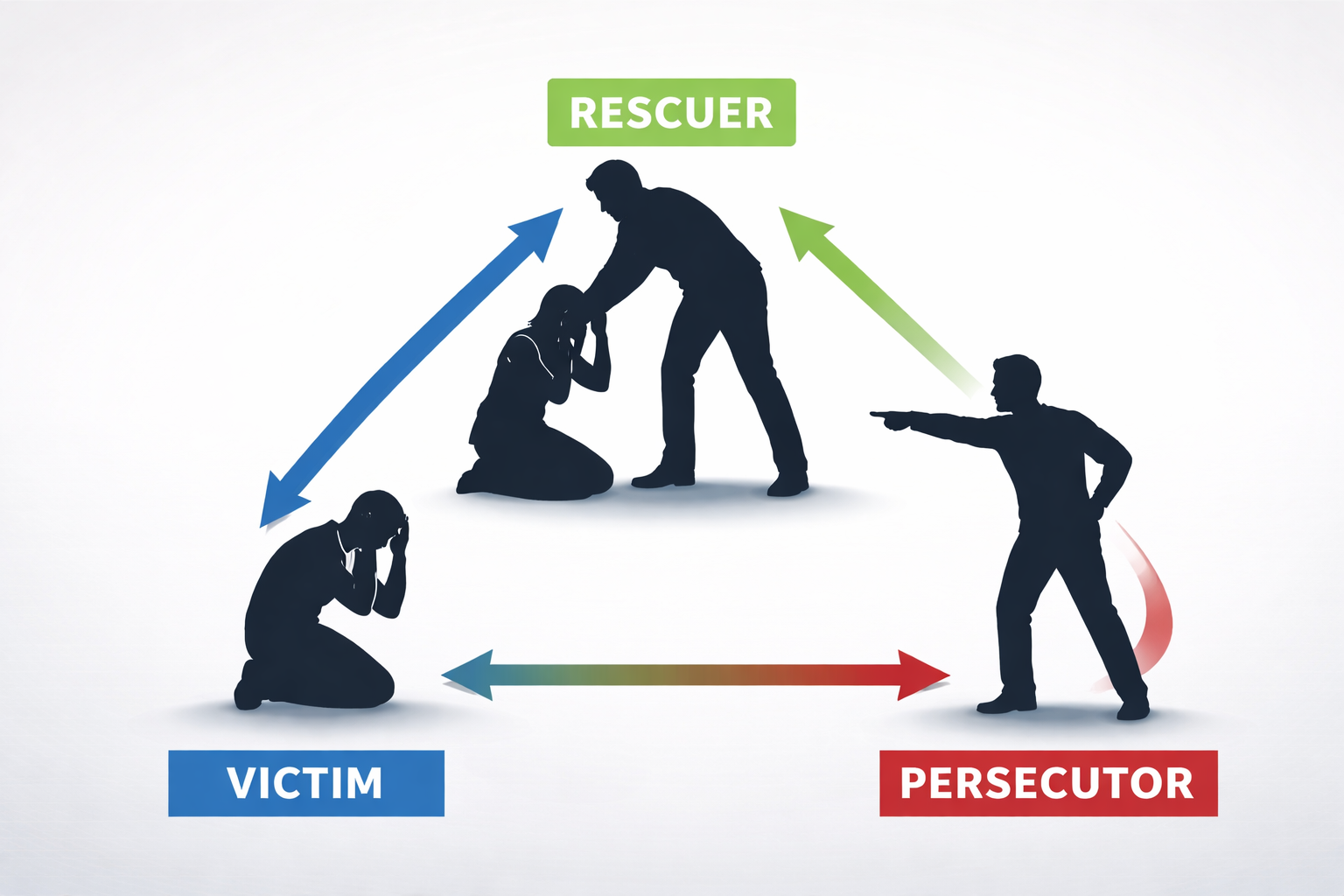
The Victim role is usually the easiest to feel and the hardest to name. It's the position where a person experiences themselves as stuck, powerless, hard done by, or unable to change what is happening. Someone in this position may say they don't know what to do, that nothing ever changes, or that other people keep letting them down. The Victim role tends to involve a reduced sense of agency. The focus stays on the problem, on what isn't working, or on what other people are doing wrong.
The Rescuer role often enters the scene quickly. This is the person who steps in, tries to solve things, gives advice, smooths things over, or takes responsibility for someone else’s difficulty. On the surface, this can look helpful, generous, or caring. Sometimes it is all of those things. But in this pattern, the helping often moves faster than reflection. The Rescuer doesn't always stop to ask what the other person actually needs. They may assume that if they do enough, say enough, or offer the right solution, the problem will go away.
The Persecutor role is the one people usually recognise most easily, because it tends to sound sharper. It can show up as blame, criticism, pressure, control, or hostility. This is the role that says, directly or indirectly, “This is your fault,” or “Why can’t you get this right?” The Persecutor role can appear in loud or aggressive form, but also through sarcasm, moral superiority, coldness, or cutting remarks. It often enters when frustration has been building for some time.
One of the most important things to understand about the Drama Triangle is that people don't stay neatly in one role. They move. A person can start in the Victim role, shift into Rescuer when trying to regain control, and then move into Persecutor when their effort is not appreciated. The movement between the roles is what keeps the pattern alive.
Examples
-
One friend shares that they are struggling at work. They feel overwhelmed, unsupported, and unsure what to do next. The other person listens, asks a few questions, and then starts suggesting solutions. They explain what they would do, how the situation could be approached, or how things might be organised differently. At first, this feels constructive and engaged. A few days later, the same issue is raised again, with nothing changed. This time the tone shifts. The response carries impatience: “You keep complaining about this, but you are not actually doing anything about it.” In that moment, the first person is in the Victim role. The second has moved into Rescuer. When the help doesn't lead to change, that position shifts into Persecutor.
-
The same pattern often appears in romantic relationships. One partner says, “You never listen to me.” The other replies, “I am trying to help you.” At first, that response may sound reasonable, but as the conversation continues, the tone changes. “Well maybe if you explained yourself properly, I would know what you mean.” Now the dynamic has shifted. One person feels unseen, the other feels unappreciated, and criticism enters. What started as distress and attempted support has turned into mutual pressure.
Workplaces provide another clear example. One person says they are behind on an important task. The other offers to help and takes on part of the work. The offer is accepted. Later, as their own workload becomes harder to manage, resentment starts to build. The tone shifts: “I cannot keep doing everyone else’s work.” The first person responds, “I didn't ask you to take over everything.” The pattern becomes visible here. One person starts in difficulty, the other steps in, and what initially looks like support turns into frustration and blame.
Part of what makes the Drama Triangle so persistent is that each role offers something in the short term.
The Victim role can reduce the pressure to act.
The Rescuer role can provide a sense of purpose, value, or moral clarity.
The Persecutor role can create a feeling of power or release.
In the moment, each role can feel justified. That is one reason people return to them so easily. The problem is that, over time, they wear down trust, accountability, and emotional clarity.
This is also why the model can be useful for self-understanding.
Some useful question can be:
Where do I tend to go when tension rises?
Do I move quickly into fixing?
Do I feel trapped and wait for someone else to sort things out?
Do I become critical when I feel ignored, burdened, or misunderstood?
These questions say far more about the pattern than any abstract description ever could.
Many people recognise themselves most strongly in the Rescuer role. That role often feels the most socially acceptable. It can look kind, dependable, and generous. But it also carries hidden costs. People who rescue often become resentful, over involved, and emotionally exhausted. They may feel unappreciated, while also finding it hard to stop stepping in. In some cases, helping becomes a way of managing anxiety, avoiding discomfort, or maintaining a sense of control in the relationship.
The Victim role can be harder to sit with because it touches vulnerability more directly. To see yourself there can feel exposing. Yet this role often has less to do with weakness and more to do with a narrowed sense of possibility. A person may genuinely feel trapped, unable to think clearly, or stuck in an old emotional position. The difficulty comes when that stance becomes the only available one, and responsibility keeps being located outside the self.
The Persecutor role is often the least appealing to admit to, but it is just as common. It doesn't always look like rage or cruelty, sometimes it appears as chronic irritation, dismissiveness, or a harsh inner voice. A person can persecute others, or themselves, with equal intensity. In fact, many people move between self criticism and criticism of others without even noticing the link.
Once the pattern becomes visible, the interaction can begin to change.
This doesn't mean responding differently every time or getting it right in the moment. It usually starts with noticing what is happening as it is happening. The urge to step in and fix. The shift in tone as frustration builds. The point where things start to feel stuck or heavy.
That moment matters because it creates space.
From there, the response can shift.
Instead of going straight into solutions, the question might be, “What would be helpful from me right now?”
Instead of moving into blame, it might sound like, “I can feel myself getting frustrated, so I want to pause for a second.”
Instead of staying with “nothing can be done,” the focus can shift to, “What is the next step I can take here?”
The situation may stay the same, but the position in the interaction starts to shift.
The image below adds an alternative to the Drama Triangle, often referred to as the Empowerment Dynamic. Where the original triangle focuses on Victim, Rescuer, and Persecutor, this model offers a different set of relational positions: Creator, Coach, and Challenger.
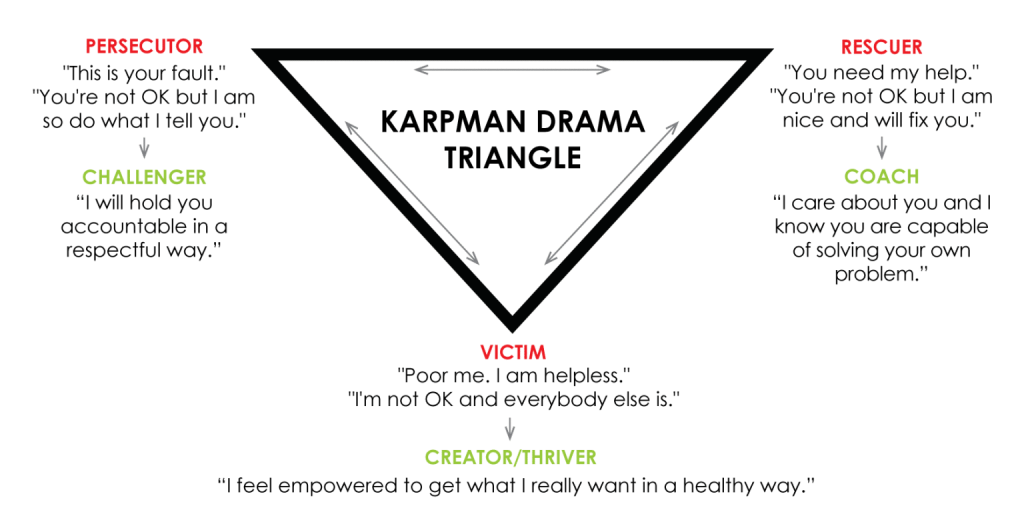
The shift from Victim to Creator is about moving from helplessness towards agency. A Creator still recognises difficulty, but doesn't stay only with what is wrong. The question becomes, “What do I want?” and “What can I do next?” That is a very different position from “Why does this always happen to me?”
The shift from Rescuer to Coach changes the whole tone of support. A Coach still cares, still listens, and still wants to help, but doesn't take over. Instead of rushing in with answers, the Coach trusts that the other person has the capacity to think, choose, and act. Coaching sounds more like, “What options do you see?” or “How can I support your next step?” It keeps responsibility with the person whose situation it is.
The shift from Persecutor to Challenger is just as important. A Challenger doesn't avoid difficulty, and doesn't pretend everything is acceptable. They may still name a problem directly. They may still hold a boundary or point out what needs to change. The difference is that the energy is no longer blame based. A Challenger asks for clarity, accountability, and movement without trying to humiliate, dominate, or punish.
This matters because the Drama Triangle, on its own, can feel descriptive but closed. It tells you what goes wrong, but not necessarily what to do instead. The Empowerment Dynamic helps fill that gap. It shows that the goal is not to stop caring, stop feeling, or stop reacting altogether. The goal is to respond from a different position.
If you recognise this pattern in your own relationships, it can help to pay attention to the situations where it appears most easily. It may happen around family, where old roles tend to return quickly. It may appear at work, especially when responsibility is unclear and pressure is high. It may surface most strongly in close relationships, where longing, frustration, and dependency sit very close together. The setting matters, because some environments invite the pattern more strongly than others.
The Karpman Drama Triangle explains a great deal about the emotional choreography of difficult interactions. It helps make sense of why support turns into resentment, why vulnerability turns into blame, and why some conversations leave you feeling as though you have been in them many times before.