
Mother Wound and Father Wound: Understanding Emotional Imprints and Healing Through Inner Child Work
- Carlotta Self Healing Clinic
- Childhood Work
Since working with the inner child, I have seen how much of our present experience comes from early emotional patterns. The more I explore, the clearer it becomes that many reactions, fears, and behaviours trace back to experiences that were inconsistent, distant, or missing.
So much of what we experience now is influenced by the past. But, I don’t believe we need to uncover every single past experience to move forward; that would be impossible and exhausting, but if, like me, you enjoy exploring your own behaviour, thoughts, and emotions, this work can be really revealing and illuminating.
Through this process, I discovered the concepts of the mother wound and father wound. They helped me make sense of patterns I recognised in myself, as insight into what my younger self still needed.
This work is not about blaming parents or assuming they didn’t love us; even with the best intentions, parents can make mistakes. We all make mistakes and sometimes unintentionally hurt others. A parent might have been tired, stressed, or distracted and missed moments when we needed comfort, or they might have said something they thought was helpful that left us feeling unseen. They acted with the knowledge, maturity, and emotional resources they had at the time. Seeing this helps us understand that any gaps, inconsistencies, or unmet needs were not a reflection on us, but simply part of what was possible for them then.
At the same time, these early experiences can leave patterns that follow us into adulthood. You might feel stuck, or notice that the past still has influence over your choices, emotions, or relationships. Working with these patterns matters if you feel a pull to explore yourself, understand your behaviour, or meet needs that were left unmet. This is about responding to yourself now with care, guidance, and reassurance, giving your younger self what was missing so it can support you today.
Understanding the Mother and Father Wound
These imprints live within the body, the nervous system, and the patterns that guide how we relate to ourselves and others. The mother and father wounds are not fixed definitions, but ways to understand how our sense of safety, belonging, and worth developed in response to those early experiences.
The mother wound often connects to how we feel held, understood, and emotionally safe. It can influence how much we trust our intuition and whether we allow ourselves to receive care and support. The father wound often relates to confidence, direction, and the sense that we can stand on our own while feeling supported. When either of these experiences was uncertain, we adapted, perhaps by becoming overly self-reliant, keeping emotions hidden, or trying to earn love through effort or achievement.
These patterns can be quiet and subtle. They may not appear as specific memories, but as undercurrents that influence how we feel day to day: a hesitation to rely on others, discomfort with being seen, or the fear of disappointing someone. They may also appear in how we treat ourselves, pushing too hard, doubting our abilities, or finding it difficult to rest without guilt.
Over time, these wounds can influence how we move through the world, often without us realising. Exploring them is about becoming aware of what still feels tender inside us. When we notice those moments, the pull to please, the urge to withdraw, the inner voice that questions our worth, we can meet them with curiosity and care rather than judgement.
Many parents, although they did their best while carrying their own wounds and emotional burdens, sometimes lacked the support, maturity, and understanding needed to respond to us in the way we required. Acknowledging this doesn't erase the impact of what we experienced, but it helps us hold a fuller picture that includes compassion alongside truth.
As we grow in awareness, we start to respond differently to the parts of ourselves that once felt unseen or unsupported. We start to offer the emotional safety, patience, and reassurance that were once missing. This is how healing unfolds, not through effort or control, but through gentle attention, through presence, and through the willingness to care for ourselves in new ways.
What Is the Mother Wound?
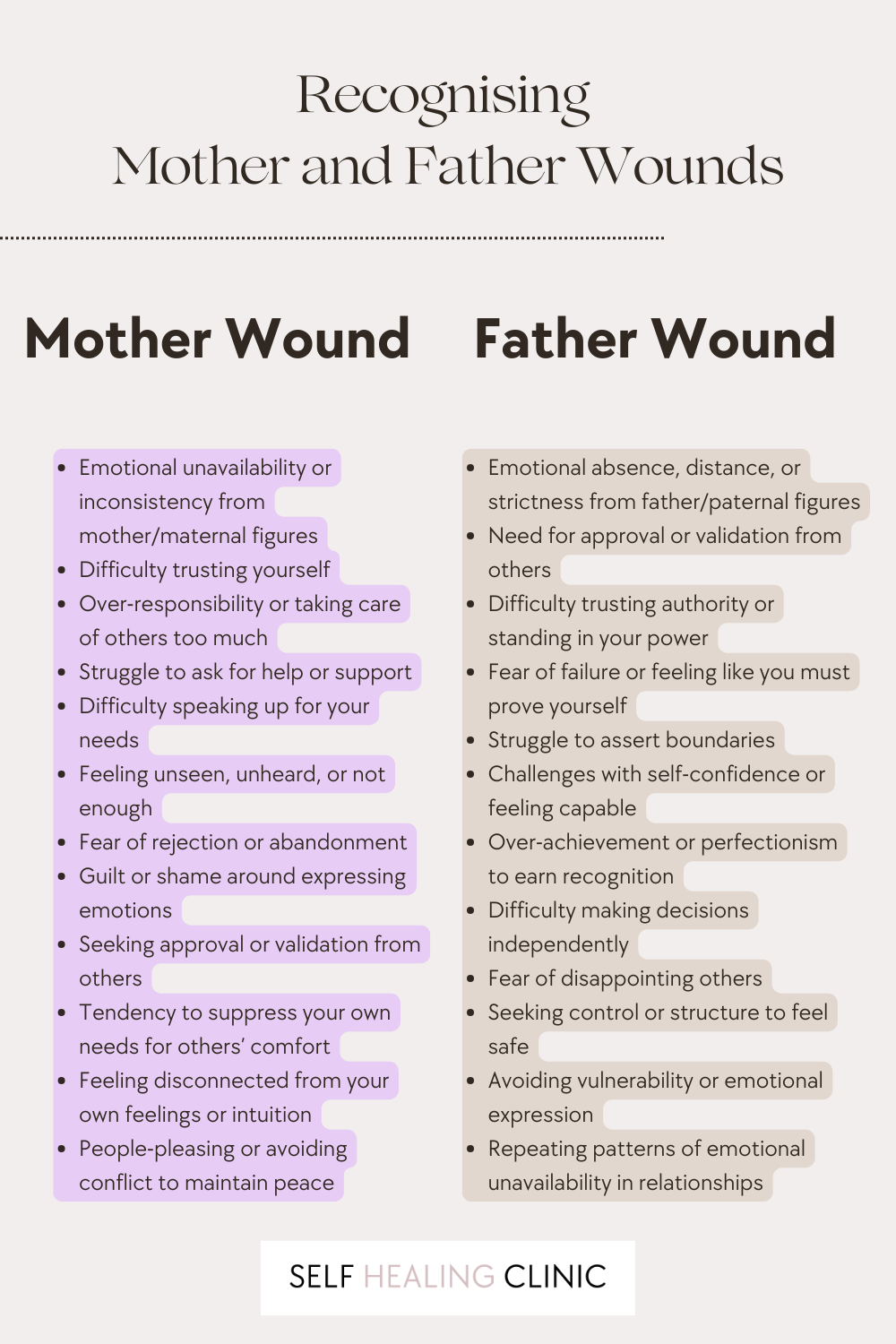
The mother wound comes from emotional unavailability, inconsistency, or criticism from a mother or maternal figure. It can show up in adulthood in ways such as:
Difficulty trusting yourself
Taking on too much responsibility for others
Struggling to ask for help or support
Difficulty speaking up for your needs
Feeling unseen, unheard, or not enough
Trouble connecting with your emotions
Challenges receiving care even when it is offered
These patterns often come from adapting as a child to survive emotionally, learning that your needs might not be fully met. This can influence relationships, self-compassion, and emotional regulation.
Reflection prompts you could try:
What feelings come up when you notice you are over-giving or avoiding help?
When do you feel unseen or unheard, and what would you have needed in those moments?
How do you respond to your own emotions, and could your younger self benefit from more reassurance?
What Is the Father Wound?
The father wound emerges when a father or paternal figure is distant, emotionally absent, demanding, or inconsistent. Adult patterns often include:
Seeking constant approval
Difficulty trusting your own decisions
Fear of failure or over-achieving to feel worthy
Challenges with self-confidence and self-reliance
Struggling to assert boundaries
Repeating relational patterns or inner criticism
These patterns reflect the child’s attempt to cope with inconsistent or unavailable validation.
Reflection prompts you could try:
What areas of your life feel driven by a need for approval or recognition?
Where do you notice self-doubt or difficulty making decisions?
How could you offer your younger self guidance or reassurance in moments of fear or uncertainty?
Differences Between Mother and Father Wounds
Though both originate from early caregiver relationships, they carry different emotional and behavioural patterns.
Many people carry both, but the way they appear differs, the mother wound tends to influence emotional connection, while the father wound tends to influence confidence and action.
Understanding the Role of Attachment
Mother wounds and father wounds are closely connected to early attachment patterns. These early experiences can create anxious attachment, where we may worry about being abandoned or constantly seek reassurance; avoidant attachment, where we distance ourselves emotionally or rely heavily on independence; or ambivalent attachment, where we fluctuate between seeking closeness and pulling away.
A mother who was emotionally inconsistent can make it difficult to trust our own feelings, while a father who was distant or critical may leave us uncertain about our abilities or the choices we make. These experiences continue to influence how we relate to ourselves, navigate relationships, and respond emotionally throughout adulthood.
Understanding the link between attachment and these wounds helps explain why certain emotional patterns and habits emerge in adulthood. When we bring awareness to these patterns, we can begin to offer the care and reassurance that our younger self needed, which allows us to approach ourselves and our relationships with more steadiness and compassion.
For a deeper exploration of how early relationships shape adult behaviours, including emotional patterns from mother and father wounds, you can read more here.
Inner Child Work and Healing
Working with your inner child is one way to start meeting unmet emotional needs. This work is about connecting with the younger self who needed care, guidance, and reassurance.
Practical, first steps:
Reflect: Notice patterns or triggers in your life linked to unmet needs.
Write: Journal what comes up when you reflect on your younger self.
Visualise: Imagine the supportive presence of an inner mother or father.
Offer reassurance: Speak to yourself with the words your younger self needed: “I see you. You are safe. You matter.”
Practice self-validation: Pause when seeking external approval and acknowledge your own effort.
Set boundaries: Notice where you over-give or avoid asking, and practice saying what you need.
These steps are small, but they begin the process of creating internal safety, care, and presence. The more you practice, the more your younger self learns to trust and rely on you.
Moving Forward with Compassion
Mother wounds and father wounds are traces of what was missing or inconsistent, and recognising them helps us meet those needs now. Healing is not about doing it all at once, but about bringing curiosity and care to what we notice. It is about connecting with our inner child, understanding what they needed, and beginning to offer it ourselves.
I will be adding this work on the mother and father wounds to the Inner Child and Teenage Program, with guided reflections and exercises to help you explore these emotional patterns gently and at your own pace.